
Suzhou Pharmaceutical Technology Co., Ltd. (China) supplies Quercetin Dihydrate Ingredient CAS 6151-25-3 for pharmaceutical B2B procurement — COA, MSDS, and technical documentation available on request.
> Quercetin Dihydrate Ingredient — Overview
Quercetin dihydrate (CAS: 6151-25-3, also known as quercetin dihydrate, quercetine dihydrate, and 3,3′,4′,5,7-pentahydroxyflavone dihydrate) is a plant-derived flavonoid dihydrate ingredient used in formulation, analytical-development, and research programs where local regulations permit. Suzhou Pharmaceutical Technology Co., Ltd. supplies Quercetin Dihydrate Ingredient in controlled small-batch and bulk quantities from Suzhou, China, with export to South America, Australia, New Zealand, Mexico, Canada, and worldwide markets. Export documentation: COA and MSDS standard for all orders.
| Product Name | Quercetin dihydrate |
| Structural Formula | 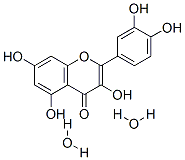 |
| Alias | Quercetin dihydrate; quercetine dihydrate; quercetin (dihydrate); 3,3′,4′,5,7-pentahydroxyflavone dihydrate; MFCD00149487 |
| CAS Number | 6151-25-3 |
| Molecular Formula | C15H14O9 |
| Molecular Weight | 338.27 g/mol |
| Purity | Available by agreed HPLC specification |
| Appearance | Yellow crystalline powder |
| Storage | Store sealed, protected from moisture and strong light |
> Applications
Quercetin dihydrate is used by pharmaceutical, nutraceutical-ingredient, and research organizations developing flavonoid dihydrate formulations, reference methods, and impurity-control strategies. Ingredient supply is intended for qualified buyers who will confirm dosage form, impurity strategy, residual-solvent limits, local specification approach, and finished-product registration obligations in their own markets.
Flavonoid dihydrate formulation research
A 2021 Heliyon study validated an HPLC-DAD method for quercetin quantification in nanoparticle work, providing chromatographic context for formulation and analytical development (doi:10.1016/j.heliyon.2021.e06553). PubChem compound record CID 5284452 lists Quercetin dihydrate as C15H14O9 with InChIKey GMGIWEZSKCNYSW-UHFFFAOYSA-N, providing identity context for analytical-development programs.
Analytical and impurity-control development
Buyers typically evaluate assay, related substances, quercetin dihydrate related profile, residual solvents, loss on drying, identity, particle-size requirement, and stability behavior before moving from sample quantities to pilot or commercial batches. We supply bulk ingredient only, not finished consumer products, compounded preparations, or branded medicines.
> Sourcing & Supply
Suzhou Pharmaceutical Technology Co., Ltd. is an R&D-driven pharmaceutical company with purification and analytical capability for Quercetin Dihydrate Ingredient. Small batches (up to 10 kg) are prepared directly by our technical team in Suzhou. For larger commercial quantities, production is scaled up at qualified manufacturing facilities, with export documentation provided according to the order scope.
- Small-batch orders (≤10 kg): prepared by our technical team in Suzhou. Lead time 10–14 business days from order confirmation.
- Commercial bulk (>10 kg): scaled up at qualified manufacturing facilities. Lead time 14–21 business days depending on batch size and documentation.
We export Quercetin Dihydrate Ingredient to buyers across South America — including Brazil, Argentina, Colombia, Chile, Peru, Ecuador, Bolivia, Paraguay, and Uruguay — as well as to Australia, New Zealand, Mexico, and Canada. Inquiries from European, Middle Eastern, and Asian markets are also welcome.
> Quality & Export Documentation
Each Quercetin Dihydrate Ingredient order is supplied against the agreed specification. Standard release controls can include appearance, identification, assay by HPLC, related substances, quercetin dihydrate related profile, loss on drying, and residual solvents when required by the order scope.
- COA: included with every order.
- MSDS: included with every order.
- COO: available for pallet quantities and commercial export orders.
- Additional package: specification sheet, chromatogram, residual-solvent data, and stability-related information can be discussed before order confirmation.
> Packaging & Storage
Quercetin Dihydrate Ingredient is packed in sealed foil bags or foil-lined fibre drums, with secondary protection selected according to quantity and shipping route. Store sealed and protect from moisture and strong light.
> Pricing & Order Information
Pricing is quoted case by case based on quantity, specification, documentation, destination country, and shipping requirements. MOQ is typically 100 g, and sample quantities of 10–50 g are available for qualified buyers before pilot or commercial orders.
> FAQ
What is the minimum order quantity for Quercetin Dihydrate Ingredient?
The minimum order quantity for Quercetin Dihydrate Ingredient is typically 100 grams. Sample quantities of 10–50 g are available for qualified buyers.
What documents are included with a Quercetin dihydrate bulk order?
All Quercetin dihydrate orders include a COA and MSDS in English. For pallet quantities and commercial export orders, COO is available as standard export documentation.
Can I request a Quercetin dihydrate sample before placing a bulk order?
Yes. Sample quantities of 10–50 g are available for qualified buyers before pilot or commercial orders.
Do you export Quercetin Dihydrate Ingredient to South America?
Yes. We handle inquiries from Brazil, Argentina, Colombia, Chile, Peru, Ecuador, Bolivia, Paraguay, and Uruguay.
Is Quercetin Dihydrate also known as quercetin-2-hydrate — what does CAS 6151-25-3 refer to?
Yes. Quercetin dihydrate is the hydrated form name used for CAS 6151-25-3; we supply bulk ingredient, not branded retail product.
Can buyers in Australia, New Zealand, Mexico, or Canada order Quercetin Dihydrate Ingredient?
Yes. We handle qualified inquiries from Australia, New Zealand, Mexico, Canada, and other international markets.
What specification is available for Quercetin dihydrate CAS 6151-25-3?
Quercetin dihydrate is supplied by agreed HPLC specification, including assay, related substances, residual solvents, loss on drying, identity, and quercetin dihydrate related profile when required.
How is Quercetin dihydrate packaged and shipped internationally?
Quercetin Dihydrate Ingredient is shipped in foil bags or foil-lined fibre drums with protection from moisture and strong light during international transit.
Do you supply finished Quercetin dihydrate dosage forms?
No. We supply Quercetin Dihydrate Ingredient, not finished consumer products, retail supplement products, or branded medicines.
What is Quercetin dihydrate used for in development programs?
Quercetin dihydrate is used in flavonoid dihydrate formulation, analytical-development, and research programs where local regulations permit.
> Related Products
- Coenzyme Q10 | CAS 303-98-0 — ubiquinone ingredient
- Quercetin Dihydrate | CAS 6151-25-3 — flavonoid ingredient
- Curcumin | CAS 458-37-7 — polyphenol ingredient
- Resveratrol | CAS 501-36-0 — stilbene ingredient
> Request a Quote or Sample
To request a quote or sample for Quercetin Dihydrate Ingredient (CAS 6151-25-3), please contact us directly at Info@fmyykj.com.
Include in your inquiry: required quantity (grams or kg), destination country, documentation requirements (COA + MSDS standard; COO for bulk), quercetin dihydrate related profile requirement if applicable, and intended use (formulation / analytical development / research / other). We respond to all inquiries within 1 business day.
Last reviewed: June 2026