
Suzhou Pharmaceutical Technology Co., Ltd. (China) supplies Spinosad API CAS 131929-60-7 for pharmaceutical B2B procurement — COA, MSDS, and technical documentation available on request.
> Spinosad API — Overview
Spinosad (CAS: 131929-60-7, also known as spinosyn A, spinosad factor A, spinosyn-A, Lepicidin A, Comfortis active ingredient, and A 83543A) is a spinosyn-class insecticidal active ingredient used in veterinary ectoparasite, agricultural insect-control, and research programs where local regulations permit. Suzhou Pharmaceutical Technology Co., Ltd. supplies Spinosad API in bulk from Suzhou, China, with export to South America, Australia, New Zealand, Mexico, Canada, and worldwide markets. Export documentation: COA and MSDS standard for all orders.
| Product Name | Spinosad |
| Structural Formula | 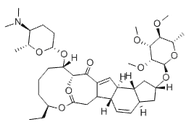 |
| Alias | Spinosyn A; Spinosad factor A; Spinosyn-A; Lepicidin A; Comfortis active ingredient; A 83543A |
| CAS Number | 131929-60-7 |
| Molecular Formula | C41H65NO10 |
| Molecular Weight | 732.0 g/mol |
| Purity | Available by agreed HPLC specification |
| Appearance | White to light tan powder |
| Storage | Store sealed, protected from light and moisture |
> Applications
Spinosad is used by veterinary, agrochemical, and research organizations developing insect-control products. API supply is intended for qualified buyers who will confirm formulation route, target species or crop, label claims, residue requirements, and finished-product registration obligations in their own markets.
Veterinary flea-control formulation research
In preliminary controlled studies on dogs, spinosad doses produced 99.8–100% effectiveness against live flea counts at 7, 14, and 21 days after treatment compared with controls (Veterinary Parasitology, 2008, doi:10.1016/j.vetpar.2008.04.028, PMID:17980490). This supports Spinosad API relevance for veterinary ectoparasite formulation research.
Agricultural insect-control development
Buyers typically evaluate assay, component profile, related substances, residual solvents, water content, particle behavior, and stability data before moving from sample quantities to pilot or commercial batches. We supply active ingredient only, not finished veterinary tablets, crop-protection formulations, or consumer products.
> Sourcing & Supply
Suzhou Pharmaceutical Technology Co., Ltd. is an R&D-driven pharmaceutical company with in-house synthesis and analytical capability for Spinosad API. Small batches (up to 10 kg) are produced directly by our technical team in Suzhou. For larger commercial quantities, production is scaled up at qualified manufacturing facilities, with export documentation provided according to the order scope.
- Small-batch orders (≤10 kg): prepared by our technical team in Suzhou. Lead time 10–14 business days from order confirmation.
- Commercial bulk (>10 kg): scaled up at qualified manufacturing facilities. Lead time 14–21 business days depending on batch size and documentation.
We export Spinosad API to buyers across South America — including Brazil, Argentina, Colombia, Chile, Peru, Ecuador, Bolivia, Paraguay, and Uruguay — as well as to Australia, New Zealand, Mexico, and Canada. Inquiries from European, Middle Eastern, and Asian markets are also welcome.
> Quality & Export Documentation
All Spinosad shipments are accompanied by a Certificate of Analysis (COA) confirming identity, appearance, assay, and related substances against batch specification. Purity is tested by HPLC against an authenticated reference standard. MSDS is provided for all orders, and Certificate of Origin (COO) is available for commercial bulk shipments.
| Order size | Documentation included |
| ≤10 kg (small-batch / research) | COA + MSDS |
| >10 kg (commercial bulk) | COA + MSDS + COO |
> Packaging & Logistics
- 100 g, 500 g: double-layered aluminium foil bag, heat-sealed, nitrogen-purged
- 1 kg: aluminium foil bag inside kraft paper box
- 5 kg, 10 kg: aluminium foil bag inside fibre drum
- >10 kg: packaging agreed according to commercial order requirements
Spinosad API is shipped with light- and moisture-protective packaging and batch labels matched to the COA. Shipping options include express courier for sample and kilogram quantities, air freight for 1–10 kg orders, and sea freight for larger commercial shipments where timing allows.
> Pricing & Supply
Spinosad pricing is provided on request. We do not publish list prices because the final quote depends on order quantity, purity requirement, documentation needs, shipping destination, and current raw material costs.
- MOQ: 100 g for qualified buyers
- Sample policy: 10–50 g samples available for formulation evaluation or analytical confirmation
- Bulk discount tiers apply at 500 g, 1 kg, 5 kg, and 10 kg
- Payment: T/T (bank transfer). 100% in advance for standard orders. Terms for larger repeat orders by arrangement.
> Frequently Asked Questions
What is the minimum order quantity for Spinosad API?
The minimum order quantity for Spinosad API is 100 grams. Sample quantities of 10–50 g are available for qualified buyers before pilot or commercial orders.
What documents are included with a Spinosad bulk order?
All Spinosad orders include a COA and MSDS in English. For commercial bulk orders above 10 kg, COO is available as standard export documentation.
Can I request a Spinosad sample before placing a bulk order?
Yes. Sample quantities of 10–50 g are available for qualified buyers. Samples are normally dispatched within 7 business days of inquiry confirmation.
Do you export Spinosad API to South America?
Yes. We support Spinosad API inquiries from Brazil, Argentina, Colombia, Chile, Peru, Ecuador, Bolivia, Paraguay, and Uruguay.
Can buyers in Australia, New Zealand, Mexico, or Canada order Spinosad?
Yes. We supply Spinosad API to buyers in Australia, New Zealand, Mexico, and Canada. COA and MSDS are included with all orders.
What is Spinosad used for?
Spinosad is used as an insecticidal active ingredient for veterinary ectoparasite and agricultural insect-control products where local regulations allow.
What is the mechanism of action of Spinosad?
Spinosad acts primarily on insect nicotinic acetylcholine receptors, causing nervous-system excitation and paralysis in susceptible insects.
Is Comfortis the same as Spinosad?
Comfortis is a finished veterinary product brand whose active ingredient is spinosad. We supply bulk Spinosad API, not finished veterinary products.
What specification is available for Spinosad CAS 131929-60-7?
Spinosad is supplied by agreed HPLC specification, including assay and component-profile controls defined before order confirmation.
How is Spinosad packaged and shipped internationally?
Spinosad API is shipped in foil bags or foil-lined fibre drums with protection from light and moisture during international transit.
> Related Products
- Milbemycin Oxime | CAS 129496-10-2 — Veterinary antiparasitic API
- Selamectin | CAS 220119-17-5 — Veterinary antiparasitic API
- Doramectin | CAS 117704-25-3 — Veterinary endectocide API
- Moxidectin | CAS 113507-06-5 — Veterinary endectocide API
> Request a Quote or Sample
To request a quote or sample for Spinosad API (CAS 131929-60-7), please contact us directly at Info@fmyykj.com.
Include in your inquiry: required quantity (grams or kg), destination country, documentation requirements (COA + MSDS standard; COO for bulk), and intended use (veterinary formulation / agricultural formulation / research / other). We respond to all inquiries within 1 business day.
Last reviewed: June 2026