
Suzhou Pharmaceutical Technology Co., Ltd. (China) supplies Tobramycin Sulfate API CAS 79645-27-5 for pharmaceutical B2B procurement — COA, MSDS, and technical documentation available on request.
> Tobramycin Sulfate API — Overview
Tobramycin Sulfate (CAS: 79645-27-5, also known as tobramycin sulfate API, deoxykanamycin B sulfate, nebramycin factor 6 sulfate, aminoglycoside API, and tobramycin sulfate salt) is an aminoglycoside API used in formulation, analytical-development, and research programs where local regulations permit. Suzhou Pharmaceutical Technology Co., Ltd. supplies Tobramycin Sulfate API in controlled small-batch and bulk quantities from Suzhou, China, with export to South America, Australia, New Zealand, Mexico, Canada, and worldwide markets. Export documentation: COA and MSDS standard for all orders.
| Product Name | Tobramycin Sulfate |
| Structural Formula | 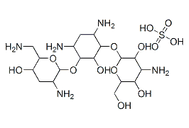 |
| Alias | Tobramycin Sulfate API; deoxykanamycin B sulfate; nebramycin factor 6 sulfate; aminoglycoside API |
| CAS Number | 79645-27-5 |
| Molecular Formula | C18H39N5O13S |
| Molecular Weight | 565.6 g/mol |
| Purity | Available by agreed HPLC or microbiological assay specification |
| Appearance | White to off-white hygroscopic powder |
| Storage | Store sealed, protected from moisture |
> Applications
Tobramycin Sulfate is used by pharmaceutical and research organizations developing aminoglycoside formulations, reference methods, and impurity-control strategies. API supply is intended for qualified buyers who will confirm dosage form, assay method, sulfate-content approach, impurity requirements, pharmacopoeial strategy, and finished-dose registration obligations in their own markets.
Aminoglycoside formulation research
A 1999 New England Journal of Medicine randomized, placebo-controlled multicenter study evaluated intermittent aerosolized tobramycin solution in a controlled clinical research setting (N Engl J Med, doi:10.1056/NEJM199901073400104, n=520 randomized). This supports the need for carefully controlled Tobramycin Sulfate API quality in aminoglycoside formulation and analytical-development programs.
Analytical and impurity-control development
Buyers typically evaluate identity, assay, related substances, sulfate content, water content, pH, residual solvents, elemental impurities, microbial limits when required, and stability behavior before moving from sample quantities to pilot or commercial batches. We supply API only, not finished dosage forms, compounded preparations, or branded medicines.
> Sourcing & Supply
Suzhou Pharmaceutical Technology Co., Ltd. is an R&D-driven pharmaceutical company with in-house synthesis and analytical capability for Tobramycin Sulfate API. Small batches (up to 10 kg) are produced directly by our technical team in Suzhou. For larger commercial quantities, production is scaled up at qualified manufacturing facilities, with export documentation provided according to the order scope.
- Small-batch orders (≤10 kg): prepared by our technical team in Suzhou. Lead time 10–14 business days from order confirmation.
- Commercial bulk (>10 kg): scaled up at qualified manufacturing facilities. Lead time 14–21 business days depending on batch size and documentation.
We export Tobramycin Sulfate API to buyers across South America — including Brazil, Argentina, Colombia, Chile, Peru, Ecuador, Bolivia, Paraguay, and Uruguay — as well as to Australia, New Zealand, Mexico, and Canada. Inquiries from European, Middle Eastern, and Asian markets are also welcome.
> Quality & Export Documentation
All Tobramycin Sulfate shipments are accompanied by a Certificate of Analysis (COA) confirming identity, appearance, assay, sulfate content, and related substances against batch specification. MSDS is provided for all orders, and Certificate of Origin (COO) is available for commercial bulk shipments.
| Order size | Documentation included |
| ≤10 kg (small-batch / research) | COA + MSDS |
| >10 kg (commercial bulk) | COA + MSDS + COO |
> Packaging & Logistics
- 100 g, 500 g: double-layered aluminium foil bag, heat-sealed
- 1 kg: aluminium foil bag inside kraft paper box
- 5 kg, 10 kg: aluminium foil bag inside fibre drum
- >10 kg: packaging agreed according to commercial order requirements
Tobramycin Sulfate API is shipped with moisture-protective packaging and batch labels matched to the COA. Shipping options include express courier for samples, air freight for kilogram orders, and sea freight for larger commercial shipments where timing allows.
> Pricing & Supply
Tobramycin Sulfate pricing is provided on request. We do not publish list prices because the final quote depends on order quantity, assay requirement, sulfate-content requirement, documentation needs, shipping destination, and current raw material costs.
- MOQ: 100 g for qualified buyers
- Sample policy: 10–50 g samples available for analytical confirmation
- Bulk discount tiers apply at 500 g, 1 kg, 5 kg, and 10 kg
- Payment: T/T (bank transfer). 100% in advance for standard orders. Terms for larger repeat orders by arrangement.
> Frequently Asked Questions
What is the minimum order quantity for Tobramycin Sulfate API?
The minimum order quantity for Tobramycin Sulfate API is 100 grams. Sample quantities of 10–50 g are available for qualified buyers.
What documents are included with a Tobramycin Sulfate bulk order?
All Tobramycin Sulfate orders include a COA and MSDS in English. For commercial bulk orders above 10 kg, COO is available as standard export documentation.
Can I request a Tobramycin Sulfate sample before placing a bulk order?
Yes. Sample quantities of 10–50 g are available for qualified buyers before pilot or commercial orders.
Do you export Tobramycin Sulfate API to South America?
Yes. We support inquiries from Brazil, Argentina, Colombia, Chile, Peru, Ecuador, Bolivia, Paraguay, and Uruguay.
Can buyers in Australia, New Zealand, Mexico, or Canada order Tobramycin Sulfate?
Yes. We supply Tobramycin Sulfate API to buyers in Australia, New Zealand, Mexico, and Canada. COA and MSDS are included with all orders.
What is Tobramycin Sulfate used for?
Tobramycin Sulfate is an aminoglycoside API used in formulation, analytical-development, and research programs where local regulations allow.
Is deoxykanamycin B sulfate related to Tobramycin Sulfate?
Yes. Deoxykanamycin B sulfate is a technical synonym context for Tobramycin Sulfate; we supply API, not branded finished medicine.
What specification is available for Tobramycin Sulfate CAS 79645-27-5?
Tobramycin Sulfate is supplied by agreed assay specification, including identity, assay, sulfate content, related substances, water content, pH, and residual solvents when required.
How is Tobramycin Sulfate packaged and shipped internationally?
Tobramycin Sulfate API is shipped in foil bags or foil-lined fibre drums with protection from moisture during international transit.
Do you supply finished Tobramycin Sulfate dosage forms?
No. We supply Tobramycin Sulfate API, not finished dosage forms, compounded products, or branded medicines.
> Related Products
- Clindamycin HCl | CAS 21462-39-5 — antibacterial API
- Clarithromycin | CAS 81103-11-9 — macrolide API
- Chloramphenicol | CAS 56-75-7 — antibacterial API
- Marbofloxacin | CAS 115550-35-1 — fluoroquinolone API
> Request a Quote or Sample
To request a quote or sample for Tobramycin Sulfate API (CAS 79645-27-5), please contact us directly at Info@fmyykj.com.
Include in your inquiry: required quantity (grams or kg), destination country, documentation requirements (COA + MSDS standard; COO for bulk), assay requirement if applicable, and intended use (formulation / analytical development / research / other). We respond to all inquiries within 1 business day.
Last reviewed: June 2026