
Suzhou Pharmaceutical Technology Co., Ltd. (China) supplies Microcrystalline Cellulose CAS 9004-34-6 for pharmaceutical B2B procurement — COA, MSDS, and technical documentation available on request.
> Product Overview
Microcrystalline Cellulose (MCC, CAS 9004-34-6) is a purified, partially depolymerized cellulose material used as a pharmaceutical and nutraceutical ingredient where buyers need controlled powder properties, batch documentation, and reliable export coordination. Suzhou Pharmaceutical Technology Co., Ltd. supports Microcrystalline Cellulose sourcing for formulation trials, specification matching, and B2B procurement programs.
MCC is a polymeric excipient rather than a single small molecule. For purchasing discussions, the most useful details are grade, particle-size profile, moisture range, bulk density, compaction behavior, and packaging requirements. No therapeutic or regulatory approval is claimed.
> Applications and Technical Reference
Microcrystalline Cellulose is widely referenced in solid-dosage formulation literature as a filler, dry binder, flow-adjustment excipient, and tableting aid. Common procurement grades include PH-101, PH-102, PH-112 and PH-200, with buyer selection usually driven by particle size, moisture sensitivity, direct-compression behavior, and compatibility with the rest of the formulation system.
Thoorens et al., 2014, International Journal of Pharmaceutics, 473(1-2), 64-72, DOI: 10.1016/j.ijpharm.2014.06.055, reviewed MCC as a direct-compression binder.
> Technical Specifications
| CAS Number | 9004-34-6 |
| Product Name | Microcrystalline Cellulose |
| Structural Formula | 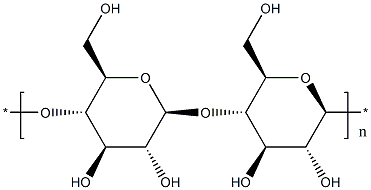 |
| Common Abbreviations | MCC; cellulose microcrystalline; cellulose gel |
| Molecular Formula | Polymeric cellulose, commonly represented as (C6H10O5)n |
| Molecular Weight | Variable polymeric material; depends on degree of polymerization |
| Appearance | White or almost white fine powder |
| Purity | According to agreed specification and batch COA |
| Typical Grades | PH-101, PH-102, PH-112, PH-200 or buyer-defined grade |
| Key Controls | Particle size, moisture, bulk density, pH, residue and microbial limits as applicable |
| Storage | Keep tightly closed in a dry, ventilated area; protect from moisture |
> Sourcing and Supply Scope
Suzhou Pharmaceutical Technology Co., Ltd. supports evaluation and pilot quantities through the Suzhou technical team for buyer evaluation and specification alignment. Commercial bulk requirements 25 kg packaging, pallet quantities or larger production campaigns are scaled up at qualified manufacturing facilities, with purchasing, documentation and logistics coordinated according to the agreed order scope.
Supported destinations include Germany, France, Italy, Spain, the United Kingdom, the Netherlands, Poland, Switzerland, the United States, Canada, Australia and New Zealand. For repeat purchasing, please share the target grade, annual forecast, packaging preference, and any local import documentation requirements.
> Quality and Documentation
For Microcrystalline Cellulose CAS 9004-34-6, the normal documentation package includes COA and MSDS. COO can be arranged for pallet quantities and commercial export orders. Buyer-specific test items can be reviewed before quotation so the supplied batch aligns with the intended technical specification.
Quality review focuses on identity, appearance, powder properties, moisture, residue, and agreed microbiological or contaminant limits where applicable. Any compendial, customer or internal specification requirement should be stated in the RFQ and confirmed against the batch COA before shipment.
> Packaging and Logistics
Typical packaging is fiber drum, carton, or multi-layer bag with inner liner, depending on grade, order size and shipping route. Labels, palletization and export documents are confirmed before dispatch. MCC should be protected from moisture during storage and transportation.
> Pricing and Lead Time
Pricing depends on grade, particle-size target, documentation scope, packaging, order quantity and destination. Please request a formal quote with CAS 9004-34-6, target grade, required quantity, delivery country, and whether the order is for evaluation or pilot quantity evaluation or 25 kg packaging, pallet quantities or larger production campaigns commercial bulk.
> Related Products
Related formulation and process materials include lactose monohydrate, low-substituted hydroxypropyl cellulose, hypromellose, magnesium stearate, dicalcium phosphate anhydrous, maltodextrin and mannitol. These materials can be discussed together when buyers are building a multi-excipient procurement list.
> FAQ
What documents are normally available for Microcrystalline Cellulose CAS 9004-34-6?
COA and MSDS are normally prepared for Microcrystalline Cellulose CAS 9004-34-6. COO can be arranged for pallet quantities and commercial export orders when required for import documentation.
Can Suzhou Pharmaceutical Technology Co., Ltd. support small MCC sample or pilot lots?
Yes. The Suzhou technical team supports evaluation and pilot quantities for Microcrystalline Cellulose evaluation, specification alignment, and early formulation screening.
How are Microcrystalline Cellulose orders for 25 kg packaging, pallet quantities or larger production campaigns handled?
Commercial bulk requirements for 25 kg packaging, pallet quantities or larger production campaigns are scaled up at qualified manufacturing facilities, with batch. Documentation and export coordination prepared according to the agreed specification.
Do you supply MCC to Germany, France and Spain?
Yes. We supply MCC to B2B buyers in Germany, France, Italy, Spain, the United Kingdom, the Netherlands, Poland and Switzerland — subject to shipment route and documentation review.
Which MCC aliases should buyers use when requesting this material?
Useful request names include Microcrystalline Cellulose, MCC, Cellulose Microcrystalline, cellulose gel, CAS 9004-34-6, and PH-101 or PH-102 grade when the target particle-size grade is known.
Can you quote different MCC grades?
Yes. Buyer requests can specify PH-101, PH-102, PH-112, PH-200 or a buyer-defined particle-size, moisture and bulk-density profile for technical review.
Do you supply MCC to the United States, Canada and Australia?
Yes. We ship MCC to B2B buyers in the United States, Canada, Australia and New Zealand. Lead time and import documentation vary by destination.
What information should be included in an RFQ?
Please include CAS 9004-34-6, target grade, quantity, destination country, document needs, packaging preference and expected purchase timing.
Is Microcrystalline Cellulose quoted from stock or made to order?
Availability depends on grade and specification. The team checks current supply, batch document readiness and export schedule before confirming a quote.
Can MCC be discussed with other excipients?
Yes. Buyers can request MCC together with lactose, hypromellose, low-substituted HPC, magnesium stearate, mannitol or other excipients.
> Request a Quote
For Microcrystalline Cellulose CAS 9004-34-6, send your target grade, quantity, destination country, documentation needs, and expected procurement timeline to Info@fmyykj.com. The team will reply with availability, technical questions if needed, and a B2B quotation path. Last reviewed: 2026-06-04.