
Suzhou Pharmaceutical Technology Co., Ltd. (China) supplies Titanium Dioxide (Rutile) CAS 13463-67-7 for pharmaceutical B2B procurement — COA, MSDS, and technical documentation available on request.
> Overview: Titanium Dioxide (TiO₂) — CAS 13463-67-7
Suzhou Pharmaceutical Technology supplies titanium dioxide (TiO₂), CAS 13463-67-7, rutile polymorph, pharmaceutical and cosmetic grade from audited Chinese manufacturers in Shandong and Sichuan provinces. Available as standard particle size (D50 0.2–0.4 µm) and micronized cosmetic grade (D50 ≤1 µm). Purity ≥99.0%, USP/EP/BP-compliant. Each batch accompanied by COA, MSDS, FTIR spectrum, and heavy-metal certificate. Minimum quantity 25 kg; bulk supply to Argentina, Colombia, Chile, Peru, Ecuador, and across South America with direct sea-freight from Shanghai or Tianjin.
> Technical Profile: Rutile vs Anatase Polymorphs
Titanium dioxide occurs in three natural polymorphs: rutile (stable, tetragonal), anatase (metastable, tetragonal), and brookite (rare). For pharmaceutical, food, and most cosmetic applications, rutile is the standard due to its higher refractive index (2.72 vs 2.55 for anatase), greater chemical stability, and lower photocatalytic activity.
| Property | Value |
|---|---|
| Product Name | Titanium Dioxide (Rutile) |
| Structural Formula | 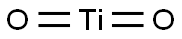 |
| CAS Number | 13463-67-7 |
| Molecular Formula | O₂Ti |
| Molecular Weight | 79.87 g/mol |
| Purity (pharma grade) | ≥99.0% |
| Appearance | White to off-white powder |
| Polymorph | Rutile |
| Refractive Index | 2.72 (rutile) |
| Density | 4.23 g/cm³ |
| Solubility | Insoluble in water and dilute acids; soluble in HF and hot H₂SO₄ |
| Loss on Drying | ≤0.5% |
| Ignition Residue | ≥99.0% |
| Storage | Cool, dry; away from moisture and strong oxidisers |
| InChIKey | GWEVSGVZZGPLCZ-UHFFFAOYSA-N |
| SMILES | O=[Ti]=O |
Anatase TiO₂ is metastable and converts irreversibly to rutile above 600 °C. For photocatalytic applications (self-cleaning surfaces, wastewater treatment), anatase is preferred. Suzhou Pharmaceutical Technology supplies rutile as the default pharmaceutical grade; anatase available on request for industrial customers.
> Regulatory Status: USP, EP, BP, E171, CI 77891
- USP (United States Pharmacopeia): Titanium Dioxide monograph; purity ≥99.0%, heavy-metal limits per ICP-MS.
- EP (European Pharmacopoeia): Titanium dioxide monograph (Ph. Eur.); water-soluble substances ≤0.3%, acid-soluble ≤0.5%.
- BP (British Pharmacopoeia): Aligned with EP monograph post-Brexit.
- E171 (EU food additive): Suspended for food use in the EU from February 2022 following EFSA re-evaluation (EFSA J. 2021;19(5):e06585, n=74 studies). Pharmaceutical excipient use is unaffected and remains approved under EMA guidelines.
- CI 77891 (EU cosmetics): Listed in Annex IV (colorants) and Annex VI (UV filters) of EU Cosmetics Regulation EC 1223/2009. Non-nano rutile permitted up to 25% in face/hand products (excluding sprays).
- FDA 21 CFR 73.575 / 21 CFR 182.90: Approved color additive and GRAS substance in the United States.
- South America: Accepted as excipient in products registered with ANMAT (Argentina), INVIMA (Colombia), ISP (Chile), DIGEMID (Peru), and ARCSA (Ecuador).
The EFSA 2021 review (doi:10.2903/j.efsa.2021.6585, n=74 studies) concluded that E171 could not be considered safe as a food additive due to genotoxicity concerns at the nano-fraction level. This conclusion does not extend to pharmaceutical uses, where TiO₂ is used as an inert excipient at controlled particle sizes under validated manufacturing conditions per ICH Q3D guidance.
> Pharmaceutical Applications
- Film-coated tablets: Aqueous coating dispersions (e.g., Opadry White) contain 1–5% TiO₂ to achieve opacity and brightness. Rutile grade with D50 ≤0.4 µm disperses uniformly without settling or agglomeration. Used by immediate-release (IR), modified-release (MR), and enteric-coated tablet lines across Latin America.
- Hard-shell capsules: TiO₂ incorporated into gelatin or HPMC capsule formulations at ≤2% w/w to produce white opaque shells, protecting light-sensitive APIs from photodegradation.
- Topical products: Physical UV filter in sunscreens, creams, and ointments. Rutile TiO₂ provides broad-spectrum UVA/UVB absorption; micronized grades improve skin aesthetics with reduced whitening.
- Oral suspensions: White pigment in paediatric suspensions and antacid formulations at 0.1–0.5% w/v.
Particle size is critical for pharma performance: coating applications require D50 0.2–0.4 µm (maximum hiding power near wavelength of visible light ~400 nm); sunscreen applications use D50 ≤1 µm to balance UV absorption and reduced whitening effect.
> Cosmetic & Sunscreen Applications (CI 77891)
- Sunscreens: Physical/mineral UV filter, SPF 15–50+ formulations. Rutile TiO₂ absorbs and reflects UVA (315–400 nm) and UVB (280–315 nm). Non-nano versions (D50 ≥100 nm) fully compliant with EU and ANVISA/INVIMA cosmetic regulations.
- Foundations, BB/CC creams: 5–25% TiO₂ provides coverage, brightening, and SPF contribution. Surface-treated grades (silica, alumina, or stearic acid coating) improve skin feel and blend.
- Lipsticks & pressed powders: 3–15% TiO₂ for white shades and blending bases; improves adhesion to lips.
- Nail products: 5–20% in white nail polishes, ridge-filler base coats.
- Hair care: Low levels (0.5–2%) in scalp treatments for UV protection.
> Quality Assurance & Documentation
- Identity: FTIR spectroscopy (confirms TiO₂ and polymorph), XRD confirmation of rutile phase
- Assay: Ignition to constant weight at 800 °C; TiO₂ content ≥99.0%
- Particle size: Laser diffraction (D10, D50, D90) per lot
- Loss on drying: ≤0.5% (105 °C, 2 h)
- Heavy metals: ICP-MS for Pb, As, Hg, Cd per USP ‹232›/‹233› and ICH Q3D
- Water-soluble substances: ≤0.3% (EP method)
- Microbial limits: TAMC ≤10² CFU/g (USP ‹2021›)
Documentation included with each shipment: COA, MSDS/SDS (16-section GHS format), FTIR spectrum, particle size distribution report, and certificate of origin. For ≤25 kg qualification orders, all documents available as digital PDFs within 24 h of shipment; for >25 kg commercial orders, physical originals included in shipment plus digital copies via email.
> Sourcing & Manufacturing Origin
China is the world’s largest TiO₂ producer, accounting for approximately 45% of global chloride-process and sulphate-process rutile capacity. Suzhou Pharmaceutical Technology sources from two qualified manufacturers in Shandong (sulphate process, cost-competitive for standard grades) and Sichuan (chloride process, higher purity for pharma/cosmetic grades).
Chloride-process TiO₂ is preferred for pharmaceutical and cosmetic applications because it produces fewer impurities (particularly sulfate residues) compared to the sulphate process. Our Sichuan supplier operates under ISO 9001 and ISO 14001. Supplier qualification records available on request.
> Packaging, Storage & Shipping
- ≤25 kg: 25-kg multi-layer kraft paper bag with PE inner liner; heat-sealed
- 25–500 kg: Same 25-kg bags on wooden pallets, stretch-wrapped
- >500 kg: 500-kg jumbo (super-sack) bags for bulk orders
Storage: Store in original packaging in a cool, dry location (≤30 °C, RH ≤65%). TiO₂ is non-flammable, non-toxic by inhalation at macroscopic particle sizes, and UN-classified as non-hazardous. Shelf life: 5 years in sealed original packaging.
Shipping: Sea freight FCL/LCL from Shanghai or Tianjin to Buenos Aires, Callao (Lima), Valparaíso, Cartagena, and Guayaquil. Air freight for qualification samples ≤5 kg. Customs HS code: 3206.11 (TiO₂ pigment). DDP and CIF Incoterms available. Typical transit: 28–35 days to Buenos Aires; 22–28 days to Callao or Guayaquil.
> Pricing & MOQ
- Pharmaceutical grade ≥99.0%: 25 kg sample from USD 4.5–6.0/kg; 100–500 kg from USD 3.2–4.5/kg; >1 t from USD 2.8–3.5/kg (chloride process, rutile)
- Cosmetic grade (CI 77891): Micronized, surface-treated: USD 5.0–7.5/kg for 100 kg; volume pricing on request
MOQ: 25 kg for first qualification order; 100 kg for repeat commercial orders. Price validity: 30 days from quotation date. All prices FOB Shanghai; CIF or DDP to South American ports available. Contact our technical sales team for a project-specific quote.
> Frequently Asked Questions
What purity grades of titanium dioxide do you supply?
Three grades: Pharmaceutical ≥99.0% (USP/EP/BP), Cosmetic ≥99.0% (CI 77891), and Technical ≥98.0%. Pharma grade includes heavy-metal limits (Pb ≤10 ppm, As ≤3 ppm) per USP monograph; cosmetic grade follows EU Cosmetics Regulation EC 1223/2009 Annex IV. All grades available as standard particle size (D50 ~0.2–0.4 µm) and micronized (D50 ≤1 µm). COA provided with each lot.
What documents are included with each titanium dioxide shipment?
Standard documentation per shipment: Certificate of Analysis (COA) with purity, particle size distribution, heavy metals, loss on drying, and ignition residue; MSDS/SDS; FTIR spectrum; and country-of-origin certificate. For regulatory submissions, we can provide factory attestation letters and DMF support documents on request. All documents are in English; Spanish translations available.
Is your titanium dioxide suitable for tablet film coating?
Yes. Our rutile-grade TiO₂ (CAS 13463-67-7) is used in aqueous film-coating suspensions (Opadry-type systems) at 1–5% w/w to achieve white opacification. Particle size D50 ≤0.4 µm ensures uniform dispersion without speckling. We supply to pharmaceutical manufacturers in Argentina, Colombia, and Chile who coat immediate-release and enteric tablets. USP/EP/BP monograph compliance confirmed per lot.
What is the CAS number (13463-67-7) for pharmaceutical-grade titanium dioxide?
CAS 13463-67-7 applies to both rutile and anatase polymorphs of TiO₂. For pharmaceutical and cosmetic use, rutile is the standard polymorph listed in USP, EP (European Pharmacopoeia), and BP (British Pharmacopoeia). In food labelling it appears as E171; in cosmetics, CI 77891. The PubChem CID is 26042. Our pharma-grade TiO₂ ships with this CAS confirmed on the COA.
Can you supply micronized TiO2 for physical sunscreen formulations?
Yes — micronized rutile TiO₂ (D50 ≤1 µm, D90 ≤3 µm) is available for cosmetic sunscreen use. At these particle sizes, TiO₂ provides broad-spectrum UVA/UVB protection with reduced whitening effect versus coarser grades. We supply coated (hydrophobic) and uncoated grades. EU Cosmetics Regulation 1223/2009 Annex VI permits rutile TiO₂ up to 25% in face and hand products (non-spray). Not for nano-grade (<100 nm) without separate regulatory notification.
What is the difference between rutile and anatase TiO2?
Rutile (tetragonal, stable) has refractive index 2.72 and better opacity/UV stability; it is the standard for pharmaceutical, cosmetic, and food applications. Anatase (tetragonal, metastable) has a lower refractive index (2.55) and stronger photocatalytic activity — used in coatings and self-cleaning surfaces but not recommended for ingested pharma forms due to photoreactivity. All our pharma/cosmetic lots are confirmed rutile polymorph by XRD.
Is E171 titanium dioxide still approved for pharmaceutical applications in Europe?
Yes. Pharmaceutical uses of TiO₂ are regulated under EU Directive 94/9/EC and remain approved as an excipient in medicinal products under EMA guidelines. National ANVISA, ISP, and INVIMA authorities also continue to accept TiO₂ in registered pharmaceutical products across South America.
What particle size options are available for titanium dioxide?
Three grades stocked: Standard (D50 0.2–0.4 µm, tablet coating), Micronized cosmetic (D50 ≤1 µm, D90 ≤3 µm, sunscreen), and Pigment grade (D50 0.2–0.3 µm, highest hiding power, coatings). Particle size distribution confirmed by laser diffraction per lot. Nano-grade (<100 nm) is available on special order but requires separate EU CPNP nano-notification for cosmetics.
What is the minimum order quantity and packaging for bulk imports to South America?
MOQ is 25 kg for sample/qualification orders; standard commercial quantities start at 100 kg. Packaging: 25-kg multi-layer paper bags (PE inner liner) for orders up to 500 kg; 500-kg jumbo bags for larger volumes. Shipment by sea freight FCL/LCL to Buenos Aires (Argentina), Callao (Peru), Valparaíso (Chile), Cartagena (Colombia), and Guayaquil (Ecuador). Lead time 3–4 weeks ex-factory after order confirmation.
How is titanium dioxide (CI 77891) used in colour cosmetics?
CI 77891 (TiO₂) serves as white pigment and opacifier in foundations, BB/CC creams, lipsticks, nail polishes, and pressed powders at 1–25% depending on formulation. It provides coverage, brightening, and SPF contribution. In foundations, particle size and surface coating (silica, alumina) determine skin-feel and blending. Our cosmetic-grade TiO₂ meets EU Cosmetics Regulation Annex IV (colorant) and Annex VI (UV filter) simultaneously when used in tinted SPF products.
Do you supply titanium dioxide to Argentina and Colombia?
Yes — Argentina and Colombia are primary markets. We ship to Buenos Aires (via port of Buenos Aires/Exolgan) and to Bogotá and Medellín (via port of Cartagena). All shipments include ANMAT/INVIMA-compatible documentation: COA, MSDS, manufacturer quality letter, and phytosanitary certificate where required. DDP and CIF terms available. Typical transit 28–35 days from Shanghai or Tianjin.
What heavy-metal limits apply to pharma-grade TiO2?
USP TiO₂ monograph specifies: Lead ≤10 ppm, Arsenic ≤3 ppm, Mercury ≤1 ppm, Cadmium ≤1 ppm (ICP-MS). EP additionally requires water-soluble substances ≤0.3% and acid-soluble substances ≤0.5%. Our COA reports all these values per lot. For INVIMA submissions in Colombia or ANMAT in Argentina, we can provide full elemental impurity data per ICH Q3D guidelines on request.
> Related Excipients & Colorants
- Zinc Sulfate (CAS 7733-02-0) — mineral supplement, ophthalmic solution ingredient
- Sucralose (CAS 56038-13-2) — high-potency sweetener for oral pharma forms
- Sucrose (CAS 57-50-1) — tablet filler, syrup base, coating sugar
- Xylitol (CAS 87-99-0) — sugar-free sweetener, caries prevention
> Request a Quote — Titanium Dioxide CAS 13463-67-7
Suzhou Pharmaceutical Technology supplies pharmaceutical and cosmetic grade titanium dioxide (CAS 13463-67-7) in quantities from 25 kg to multi-tonne lots, with full regulatory documentation. We serve importers, formulators, and manufacturers in Argentina, Colombia, Chile, Peru, Ecuador, Bolivia, Uruguay, and worldwide. Last reviewed: 2026-06-03