
Suzhou Pharmaceutical Technology Co., Ltd. (China) supplies Yellow Petrolatum USP CAS 8009-03-8 for pharmaceutical B2B procurement — COA, MSDS, and technical documentation available on request.
Yellow Petrolatum (CAS 8009-03-8) is a purified semi-solid UVCB mixture of long-chain hydrocarbons produced by Suzhou Pharmaceutical Technology Co., Ltd. as pharmaceutical-grade ointment base and skin protectant. Available in USP/EP/BP grade at ≥99% purity (per compendial specification), meeting all pharmacopoeial requirements for color, consistency, and melting range. All orders include COA and MSDS. Export to South America, Europe, and worldwide. Inquire →
> Yellow Petrolatum — Overview
Yellow petrolatum (also called yellow soft paraffin, petroleum jelly, or mineral jelly) is a semi-solid, translucent mixture of paraffinic, naphthenic, and micro-crystalline hydrocarbons derived from petroleum. Unlike white petrolatum, the yellow grade retains its natural amber-yellow color because it undergoes less intensive decolorization processing. Both grades share the same CAS number (8009-03-8) and primary pharmacopoeial monographs, but are distinguished by the absence of bleaching in the yellow form. In pharmaceutical manufacturing, yellow petrolatum is the standard choice for opaque or pigmented ointment bases, while white petrolatum is reserved for ophthalmic and skin-lightening applications requiring full transparency.
| Product Name | Yellow Petrolatum |
| Structural Formula | 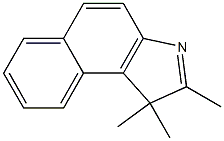 |
| Synonyms | Yellow soft paraffin; petroleum jelly; mineral jelly; yellow vaseline; Vaseline (brand); petrolatum; yellow paraffin jelly |
| CAS Number | 8009-03-8 |
| Molecular Formula | Complex UVCB mixture — long-chain hydrocarbons C20–C60 (no discrete molecular formula) |
| Purity / Grade | Pharmaceutical grade per USP 43, EP 10.0, BP 2023 |
| Appearance | Yellow to pale amber translucent semi-solid; unctuous texture; practically odorless |
| Storage | Store at room temperature (15–30°C); protect from heat, open flame, and contamination; avoid contact with oxidizing agents |
> Applications
Yellow petrolatum is one of the oldest and most extensively validated ointment bases in pharmaceutical practice. Its unique combination of occlusive barrier properties, chemical inertness, and physical plasticity makes it indispensable across pharmaceutical, veterinary, and cosmetic formulation.
Pharmaceutical Ointment Base — Topical Drug Delivery
Yellow petrolatum is the most widely used ointment base in Formularies across South America. As an oleaginous base, it promotes drug absorption through hydration of the stratum corneum via occlusion, while its chemical neutrality makes it compatible with a broad range of APIs — including antibiotics (fusidic acid, tetracycline), corticosteroids (betamethasone, hydrocortisone), antifungals, and antiseptics. Petrolatum-based ointments remain the dosage form of choice in LATAM hospital pharmacies and compounding laboratories for dermatological formulations requiring long-shelf-life stability. The FDA OTC Skin Protectant monograph (21 CFR §347.10) lists petrolatum at 30–100% as a Category I ingredient — safe and effective for prevention and treatment of dry, cracked, or irritated skin — making it one of only seven approved actives in this category.
Wound Dressings and Impregnated Gauze
Petrolatum-impregnated gauze (3% petrolatum on cotton gauze mesh) is a standard wound dressing for burns, split-thickness skin graft donor sites, and superficial abrasions. The semi-occlusive barrier maintains a moist wound environment that accelerates epithelialization while preventing wound desiccation and reducing adherence of the dressing to the wound bed. Pharmaceutical-grade yellow petrolatum is the preferred API for this application due to its longer natural stability (the aromatic fraction acts as a mild antioxidant), and yellow-tinted bases are readily identifiable from white petrolatum in compounding environments.
Veterinary Use — Udder Cream, Hoof Care, and Coat Conditioning
In veterinary practice across South America, yellow petrolatum is incorporated into teat dip emollients for dairy cattle (preventing chapping after milking), hoof care preparations for sheep and cattle (5–20% petrolatum in lanolin base), and conditioning pastes for equine coat maintenance. SENASA-registered veterinary product manufacturers in Argentina and Colombia are regular buyers of our pharmaceutical-grade yellow petrolatum for these applications. The food-contact safety of yellow petrolatum is governed by FDA 21 CFR §172.880 (petroleum naphtha) and EU Regulation 10/2011 for materials intended for food contact.
Cosmetics and Personal Care
In cosmetics, yellow petrolatum appears in lip balms, hair pomades, beard balms, and intensive skin moisturizers. The Cosmetic Ingredient Review (CIR Expert Panel, 2012) concluded that petrolatum is safe as used in cosmetics when the refinery history ensures polynuclear aromatic hydrocarbon (PAH) content is below regulatory limits. INCI name: Petrolatum. Pharmaceutical-grade petrolatum from our supply meets European Pharmacopoeia (EP 10.0) refinery specifications, which are stricter than the minimum cosmetic standard, providing assurance of PAH compliance.
> Sourcing & Supply Chain
Suzhou Pharmaceutical Technology Co., Ltd. sources yellow petrolatum from petroleum refineries with established pharmaceutical-grade production processes. Each batch undergoes compendial testing (USP/EP melting range, consistency, acidity/alkalinity, PAH content) before release.
- Export to Argentina, Colombia, Chile, Peru, Ecuador, Bolivia, Uruguay, and other South American markets
- Supply to Europe, Australia, Southeast Asia, and worldwide
- Lead time: 7–14 business days for standard quantities; larger volumes may require 3–4 weeks
- Available grades: pharmaceutical (USP/EP/BP), cosmetic (CIR-compliant, EU PAH spec), industrial
- Batch-specific COA prior to shipment confirming melting range, consistency, and PAH limits
> Quality & Export Documentation
Pharmaceutical-grade yellow petrolatum from our supply meets the following compendial specifications:
- USP 43 — Petrolatum (yellow and white monographs; melting range, consistency, residue on ignition, PAH)
- EP 10.0 — Yellow Soft Paraffin (0596; melting range 35–70°C, UV absorbance for PAH, solid paraffins)
- BP 2023 — Yellow Soft Paraffin
- FCCX — Food Chemicals Codex (food/cosmetic use)
All orders include COA and MSDS. Certificate of Origin (COO) is available for 25 kg packaging, pallet quantities, and commercial export orders. COA parameters: appearance, color (Saybolt or Lovibond), melting range (capillary method), penetration (cone penetrometer at 25°C), residue on ignition, acid/base test, PAH absorbance (EP UV method).
| Order Size | Documents Included |
| Sample or evaluation quantity | COA + MSDS |
| 25 kg packaging / pallet quantity / production campaign | COA + MSDS + COO |
> Packaging & Logistics
- 500 g, 1 kg: wide-mouth HDPE container with lid
- 5 kg: sealed metal tin or HDPE pail
- 25 kg: sealed HDPE drum (standard export)
- 180 kg: UN-approved steel drum for bulk orders
Yellow petrolatum is classified as non-hazardous (flash point typically >200°C) for air and sea transport, with no dangerous goods surcharge. Shipping options: courier (DHL/FedEx) 4–8 business days for ≤5 kg; air freight 6–12 days for 5–100 kg; sea freight 20–35 days to South American ports for >100 kg. HS code: 2712.10 (petroleum jelly).
> Pricing & Supply Terms
Yellow petrolatum price is provided on inquiry. Final pricing depends on grade (pharmaceutical vs. cosmetic), packaging format, order quantity, destination, and current crude oil derivatives market conditions.
- Minimum order: 500 g (evaluation sample); 5 kg (commercial).
- Sample policy: samples available at cost; credit toward first commercial order.
- Payment: T/T (bank transfer). Flexible terms for repeat orders.
> Frequently Asked Questions
What documents come with a yellow petrolatum order?
All orders include COA and MSDS. Orders over 10 kg also include Certificate of Origin (COO). COA tests: appearance, color, melting range (35–55°C for yellow soft paraffin EP), penetration (cone, 25°C), residue on ignition, acid/alkalinity, and PAH UV absorbance per EP 10.0. Additional documents (food-contact compliance letter, cosmetic safety statement) available on request.
What is the minimum order quantity for pharmaceutical-grade yellow petrolatum CAS 8009-03-8?
Minimum order is 500 g for evaluation samples and 5 kg for commercial use. Standard bulk sizes are 25 kg drums and 180 kg steel drums for large-volume buyers. Contact us with your required grade and quantity for a tailored quotation.
Do you export yellow petrolatum to South America?
Yes. We export pharmaceutical-grade yellow soft paraffin to Argentina, Colombia, Chile, Peru, Ecuador, Bolivia, and Uruguay. We have experience with LATAM customs documentation and can provide Spanish-language invoices and packing lists. Typical transit: 5–9 business days (courier) or 22–30 days (sea freight to Buenos Aires or Cartagena).
What is the difference between yellow petrolatum and white petrolatum?
Both yellow and white petrolatum (CAS 8009-03-8) are semi-solid hydrocarbon mixtures from the same source. White petrolatum undergoes additional bleaching (treatment with activated clay or hydrogen peroxide) to remove the natural yellow color. Both meet USP/BP monograph specifications. White is required for ophthalmic preparations and products where color-transfer to the skin must be avoided. Yellow petrolatum is preferred for dermatological ointments where cost-efficiency matters and color is not critical.
Does yellow petrolatum meet USP and European Pharmacopoeia (EP) specifications?
Yes. Pharmaceutical-grade yellow petrolatum from our supply meets USP 43 (Petrolatum) and EP 10.0 (Yellow Soft Paraffin, monograph 0596), including melting range, penetration, residue on ignition, and PAH absorbance limits. The EP 10.0 specification is generally more stringent for PAH content than USP, making EP-grade material suitable for both US and European markets.
What is the PAH (polycyclic aromatic hydrocarbon) content of your yellow petrolatum?
Pharmaceutical-grade yellow petrolatum meets EP 10.0 UV absorbance test for polynuclear aromatic hydrocarbons — absorbance at 260–420 nm must not exceed the limit specified in the monograph. This is more stringent than simple petroleum jelly and ensures food-contact and cosmetic safety. COA confirms compliance per batch.
What is the melting range of pharmaceutical-grade yellow petrolatum?
Per EP 10.0 (Yellow Soft Paraffin), the melting range is 35–70°C. USP specifies a range between 38°C and the labeled value. The typical lot-specific melting range for pharmaceutical grade is 42–55°C. Penetration at 25°C: 100–300 (0.1 mm units) by cone penetrometer method. Both are reported in the batch-specific COA.
Is yellow petrolatum suitable for compounding topical formulations in Latin American pharmacies?
Yes. Yellow soft paraffin is the most widely used ointment base in compounding (farmacias magistrales) across Argentina, Colombia, Chile, Peru, and Mexico. It is listed in the FEUM (Farmacopea de los Estados Unidos Mexicanos), Farmacopea Argentina, and other LATAM compendia. Our pharmaceutical-grade material meets USP/EP standards, providing full documentation for inclusion in magistral formulations submitted to ANMAT, INVIMA, or ANAMED.
How is yellow petrolatum (petroleum jelly) shipped internationally?
Yellow petrolatum has a flash point above 200°C and is non-hazardous under IATA/IMDG rules — no dangerous goods surcharge. Small quantities (≤5 kg) ship by courier in 4–8 business days. Larger volumes travel by air or sea freight. HS code: 2712.10. Customs duty classification as petroleum jelly applies in most jurisdictions.
Can yellow petrolatum be used in veterinary ointments and cattle care products?
Yes. Yellow petrolatum is widely used in veterinary formulations across South America: teat dip emollients for dairy cattle (prevents chapping post-milking), hoof care preparations for sheep and cattle, and conditioning pastes for equines. Veterinary product manufacturers in Argentina (SENASA-registered) and Colombia (ICA-registered) are among our regular buyers. We supply pharmaceutical-grade material with documentation suitable for veterinary product registration.
Is yellow petrolatum also known as yellow soft paraffin or petroleum jelly — what are its cosmetic applications?
In cosmetics, yellow vaseline (INCI name: Petrolatum) is used in lip balms, hair pomades, beard products, and intensive emollients. CIR Expert Panel (2012) confirmed petrolatum is safe in cosmetics when PAH specifications are met. Our pharmaceutical-grade petrolatum exceeds EU cosmetic PAH standards, making it suitable for cosmetic formulations in Europe and Latin America without additional testing.
Do you supply yellow soft paraffin to pharmaceutical manufacturers in Argentina and Colombia?
Yes. We supply yellow soft paraffin to pharmaceutical laboratories, compounding pharmacies, and cosmetic manufacturers in Argentina (ANMAT supply chain) and Colombia (INVIMA-registered manufacturers). We provide Spanish-language documents and have experience with regional import documentation requirements. Typical delivery to Buenos Aires or Bogotá: 6–10 business days by courier.
> Related Products
- White Petrolatum — CAS 8009-03-8 | Ophthalmic & Cosmetic Grade
- Stearic Acid — CAS 57-11-4 | Emulsifier & Consistency Agent
- Stearyl Alcohol — CAS 112-92-5 | Emollient & Thickener
- Propylene Glycol — CAS 57-55-6 | Humectant & Solvent
> Request a Quote or Sample
Submit an inquiry for pharmaceutical-grade or cosmetic-grade yellow petrolatum. Please specify: grade (pharma/cosmetic), packaging format, quantity, and destination country. We respond within 24 hours on business days.
Contact: Info@fmyykj.com
Last reviewed: June 2026