
Suzhou Pharmaceutical Technology Co., Ltd. (China) supplies Succinic Acid CAS 110-15-6 for pharmaceutical B2B procurement — COA, MSDS, and technical documentation available on request.
> Overview: Succinic Acid — CAS 110-15-6
Suzhou Pharmaceutical Technology supplies succinic acid, CAS 110-15-6, pharmaceutical grade (≥99.5%), from qualified Chinese manufacturers. Succinic acid (butanedioic acid) is a dicarboxylic organic acid and a natural Krebs cycle metabolite. In pharmaceutical manufacturing it functions as a microenvironmental pH modifier, succinate buffer component, salt-forming counter-ion for basic APIs, and food acidulant (E363). Complies with USP, BP (British Pharmacopoeia), and Ph. Eur. Each lot ships with COA, MSDS, and full pharmacopoeial tests. Minimum 25 kg; bulk supply to Argentina, Colombia, Chile, Peru, Ecuador, and across South America by sea freight.
> Technical Profile & Specifications
Succinic acid is the simplest saturated dicarboxylic acid (HOOC–CH₂–CH₂–COOH). Its two carboxyl groups (pKa1 4.21, pKa2 5.64) allow it to serve both as a proton donor (pH modifier) and as a buffer component over the pH range 4.5–6.5. High melting point (185–190 °C) and low hygroscopicity make it stable under hot-melt extrusion and tableting conditions.
| Property | Value |
|---|---|
| Product Name | Succinic Acid |
| Structural Formula | 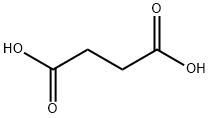 |
| CAS Number | 110-15-6 |
| Molecular Formula | C₄H₆O₄ |
| Molecular Weight | 118.09 g/mol |
| Purity (pharma grade) | ≥99.5% |
| Appearance | White crystalline powder or granules |
| Melting Point | 185–190 °C |
| Solubility in Water | 80 g/L (20 °C); 210 g/L (60 °C) |
| pKa Values | pKa1 = 4.21; pKa2 = 5.64 |
| Residue on Ignition | ≤0.05% |
| Heavy Metals | ≤5 ppm |
| Water Content | ≤0.5% (Karl Fischer) |
| Storage | Cool, dry; ≤25 °C, RH ≤60%; sealed container |
| InChIKey | KDYFGRWQOYBRFD-UHFFFAOYSA-N |
> Regulatory Status: USP, BP, Ph. Eur., E363
- USP (United States Pharmacopeia): Succinic Acid monograph; assay ≥99.5%, melting point, residue on ignition, heavy metals, organic volatile impurities.
- BP (British Pharmacopoeia): Succinic Acid monograph aligned with Ph. Eur.
- Ph. Eur. (European Pharmacopoeia): Succinic Acid (Acidum succinicum); related substances, appearance of solution, and sulfated ash specified.
- E363 (Food Additive): EU-approved acidulant and flavoring agent in food products; ADI ‘not limited’ (JECFA/WHO).
- FCC (Food Chemicals Codex): Succinic acid for food-grade use.
- South America: Accepted as excipient by ANMAT (Argentina), INVIMA (Colombia), ISP (Chile), DIGEMID (Peru), and ARCSA (Ecuador).
> Pharmaceutical Applications
- pH modifier in solid dosage forms: 1–10% w/w succinic acid in tablet or capsule formulations acidifies the microenvironment around dissolved API particles, dramatically improving dissolution of weakly basic drugs (BCS class II/IV) by maintaining them in protonated, soluble form.
- Succinate buffer (parenteral & ophthalmic): Succinic acid / sodium succinate buffer at pH 5.0–5.8, 10–25 mM concentration. Used in monoclonal antibody drug products (adalimumab, trastuzumab), lyophilized protein vials, and ophthalmic drops. Chosen for low ionic strength and minimal interference with protein stability assays.
- Pharmaceutical salt formation: Succinic acid is a preferred counter-ion for basic APIs producing crystalline, stable, soluble succinate salts. Commercial examples: metoprolol succinate (extended-release cardiovascular), sumatriptan succinate (migraine), doxylamine succinate (antihistamine).
- Co-crystal former: Succinic acid is widely used in pharmaceutical co-crystal screening as a neutral co-former with hydrogen-bond acceptor functionality, improving solubility and dissolution rate of poorly soluble APIs.
- Effervescent tablet buffer: Combined with sodium bicarbonate to provide controlled effervescence and mild acidic pH in effervescent vitamin and analgesic tablets.
> Industrial & Chemical Synthesis Applications
- Bio-based succinic acid (1,4-butanediol, PBS polymer): Industrial-scale bio-fermentation of succinic acid from glucose as a platform chemical for polybutylene succinate (PBS) biodegradable plastics, 1,4-butanediol (BDO), and tetrahydrofuran (THF) synthesis.
- Flavor & fragrance chemistry: Precursor for succinate esters used in food flavorings; E363 acidulant in processed meats, sauces, and bakery.
- Surfactant & lubricant additive: Dioctyl sodium sulfosuccinate (DOSS/DSS) is synthesized from succinic acid; used as emulsifier and docusate laxative.
> Quality Assurance & Documentation
- Assay: Acidimetric titration with NaOH; succinic acid ≥99.5% (anhydrous basis)
- Melting point: 185–190 °C (USP method)
- Residue on ignition: ≤0.05%
- Heavy metals: ICP-MS; ≤5 ppm (as Pb); USP ‹232›/‹233›
- Water content: Karl Fischer; ≤0.5%
- Organic volatile impurities: GC headspace; meets USP Class 3 residual solvents
- Microbial limits: TAMC ≤10³ CFU/g (USP ‹61›/‹62›)
Documentation included with each shipment: COA, MSDS/SDS (GHS format), and country-of-origin certificate. For ≤25 kg qualification orders, digital PDFs within 24 h of shipment; for >25 kg commercial orders, physical originals plus digital copies.
> Sourcing & Manufacturing Origin
China is one of the largest global producers of succinic acid, manufactured by both chemical synthesis (maleic anhydride hydrogenation) and bio-based fermentation routes. Suzhou Pharmaceutical Technology sources from qualified manufacturers operating pharmaceutical-grade production with USP/EP process controls, HPLC quality testing, and ISO 9001 certification. Our suppliers export to pharmaceutical companies in Europe, North America, and Latin America.
> Packaging, Storage & Shipping
- ≤25 kg: 25-kg fiber drums with PE inner liner (heat-sealed)
- 25–500 kg: 25-kg woven PP bags or multiple fiber drums on pallet
- >500 kg: 500-kg big-bags for bulk orders
Storage: Keep sealed at ≤25 °C, RH ≤60%. Succinic acid is mildly hygroscopic at high humidity; store away from strong bases (risk of neutralization). Shelf life: 5 years in sealed packaging.
Shipping: Non-hazardous (non-regulated for transport). Sea freight FCL/LCL from Shanghai or Tianjin to Buenos Aires, Callao (Lima), Valparaíso, Cartagena, and Guayaquil. HS code: 2917.19.90. Air freight for qualification samples ≤5 kg. Typical transit: 28–35 days to Buenos Aires.
> Pricing & MOQ
- Pharmaceutical grade ≥99.5%: 25–100 kg from USD 2.5–4.0/kg; 100–500 kg from USD 1.8–3.0/kg; >500 kg from USD 1.2–2.0/kg
- ACS Reagent grade ≥99.0%: 5–10% premium over pharma grade for ultra-pure lots
- Technical/Food grade (E363): 10–20% lower than pharma grade
MOQ: 25 kg for qualification; 500 kg for repeat commercial orders. Price validity 30 days from quotation. All prices FOB Shanghai; CIF or DDP to South American ports on request.
> Frequently Asked Questions
What is the minimum order quantity for pharmaceutical succinic acid — and what documents are available?
Three grades: Pharmaceutical ≥99.5% (USP/BP/Ph. Eur.), Reagent/ACS ≥99.0%, and Technical/Food grade (FCC/E363) ≥99.0%. USP monograph: assay ≥99.5%, melting point 185–190 °C, residue on ignition ≤0.05%, heavy metals ≤5 ppm. All lots ship with COA and MSDS.
What documents are included with each succinic acid shipment?
COA with assay, melting point, water content, heavy metals, residue on ignition, and appearance; MSDS/SDS (GHS); country-of-origin certificate. Factory attestation letters and DMF-support documents on request. All documents in English; Spanish translations for ANMAT, INVIMA, and ISP.
What is the CAS number 110-15-6 for succinic acid?
CAS 110-15-6 identifies succinic acid (butanedioic acid), a dicarboxylic acid. PubChem CID 1110. Formula C4H6O4, MW 118.09 g/mol. InChIKey KDYFGRWQOYBRFD-UHFFFAOYSA-N. Also known as amber acid and E363 (food acidulant). Meets USP and Ph. Eur. monograph specifications on our COA.
How is succinic acid used as a pH modifier in oral solid dosage forms?
Succinic acid (pKa1 4.21) at 1–10% w/w acidifies the microenvironment in tablet matrices, improving dissolution of weakly basic APIs by protonation in the diffusion layer.
Is succinic acid (E363) approved for use in food and dietary supplements?
Yes. E363 status in the EU; GRAS in the USA; FCC grade for food use. ADI ‘not limited’ by JECFA (WHO/FAO). Used as acidulant and flavoring in dietary supplements, effervescent products, and food encapsulation at ≤0.2% in beverages and ≤1.0% in solid foods.
What pharmaceutical salt forms use succinic acid as a counter-ion?
Succinic acid forms stable crystalline succinate salts with basic APIs. Commercial examples: metoprolol succinate (cardiovascular, extended-release), sumatriptan succinate (migraine), and doxylamine succinate (antihistamine). The succinate counter-ion improves solubility, stability, and solid-state properties versus free-base API forms.
Can succinic acid be used in parenteral formulations as a buffer component?
Yes. Succinic acid / sodium succinate buffer covers pH 4.5–6.5 (pKa2 5.64) at 10–25 mM. Used in monoclonal antibody drug products (adalimumab, trastuzumab), lyophilized protein vials, and ophthalmic drops. Low ionic strength and good protein compatibility make it a preferred parenteral buffer. Endotoxin-tested grades available.
What is the solubility and melting point of succinic acid?
Solubility: 80 g/L water (20 °C); 210 g/L (60 °C). Melting point: 185–190 °C. pKa1 = 4.21, pKa2 = 5.64. Practically insoluble in hexane and toluene; slightly soluble in ethanol (30 g/L). High melting point and low hygroscopicity support dry blending and granulation in solid dosage form manufacturing.
What packaging is available for bulk succinic acid shipments to South America?
Standard: 25-kg fiber drums with PE inner liner; 500-kg big-bags for bulk orders. Sea freight FCL/LCL to Buenos Aires, Callao (Lima), Valparaíso, Cartagena, and Guayaquil. Lead time 3–4 weeks. DDP and CIF Incoterms available.
What is the minimum order quantity for pharmaceutical succinic acid?
MOQ 25 kg for qualification; 500 kg for commercial orders. Pharma grade ≥99.5%: USD 2.5–4.0/kg at 25–100 kg (FOB Shanghai). Price validity 30 days. Contact our team for CIF pricing to your South American port.
How does succinic acid compare to citric acid, tartaric acid, and fumaric acid as excipients?
All are dicarboxylic or tricarboxylic acid excipients. pKa1 values: citric 3.13, tartaric 2.98, fumaric 3.03, succinic 4.21 (mildest). Succinic acid has the highest melting point (185 °C vs citric 153 °C): preferred for HME and heat-processed tablets. Fumaric acid less soluble, preferred for effervescent tablets. Succinic acid preferred for parenteral succinate buffers at pH 5–6.
Do you supply pharmaceutical succinic acid to Argentina and Colombia?
Yes — primary markets. We ship to Buenos Aires (Exolgan) and Bogotá/Medellín (via Cartagena). Documentation compatible with ANMAT and INVIMA: COA, MSDS, factory attestation letter. DDP and CIF available. Transit 28–35 days from Shanghai or Tianjin.
> Related Organic Acids & pH Modifiers
- Sucrose (CAS 57-50-1) — sweetener, tablet filler, sugar coating base
- Sucralose (CAS 56038-13-2) — non-caloric high-intensity sweetener, 600× sucrose
- Titanium Dioxide (CAS 13463-67-7) — opacifier for film-coated tablets and capsules
> Request a Quote — Succinic Acid CAS 110-15-6
Suzhou Pharmaceutical Technology supplies pharmaceutical-grade succinic acid (CAS 110-15-6, ≥99.5%) in quantities from 25 kg to multi-tonne lots, with full regulatory documentation. We serve importers, formulators, and manufacturers in Argentina, Colombia, Chile, Peru, Ecuador, Bolivia, Uruguay, and worldwide. Last reviewed: 2026-06-03